
What causes transverse cracks in asphalt?
Transverse cracks run across the pavement and they are thermal. Why roughly 82 freeze and thaw nights a year drive them here, and how they get repaired.
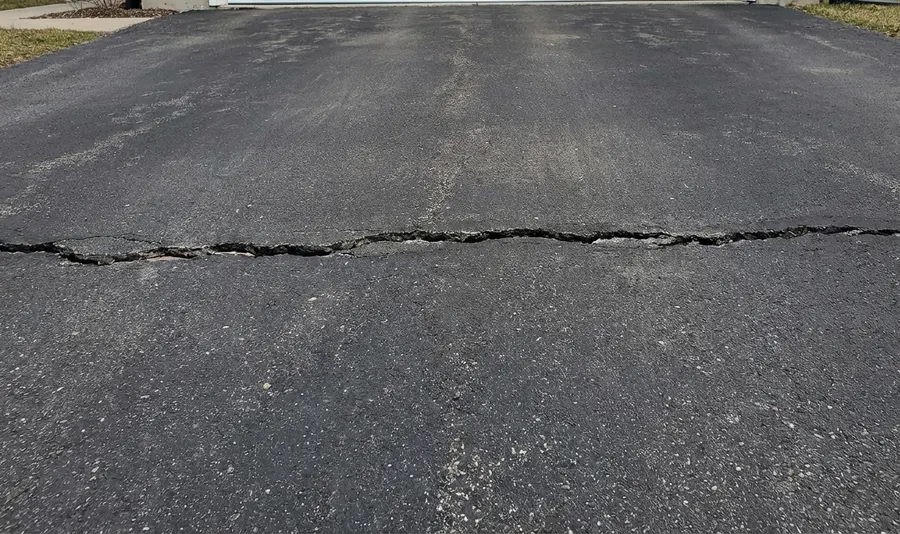
Transverse cracks run across the pavement, perpendicular to traffic. They are thermal. Asphalt shrinks as it cools, and when it cannot shrink any further it splits across its width. Boise Air Terminal records about 82 nights a year that drop below freezing and warm back above it, which is what drives them.
Why do transverse cracks form?
Asphalt contracts when it gets cold. It is a flexible material with a binder that stiffens as temperature drops, and a large surface that cools overnight wants to pull itself inward from every direction. The surface is fixed at its edges and bonded to the ground, so it cannot actually move. The stress builds until the pavement relieves it by splitting, and the split runs across the shorter dimension.
That is why transverse cracks tend to appear at fairly regular intervals down a driveway or a drive aisle. Each one relieves the stress in the stretch around it.
It is also why they show up on pavement that barely gets used. A driveway that sees two cars a day still goes through every temperature swing the weather delivers.
How does the Treasure Valley climate drive transverse cracking?
Through the number of cycles rather than the depth of the cold. This is not a place with brutal winters. It is a place with a very large number of nights that drop below freezing and days that climb back above it.
Boise Air Terminal records 100.9 nights a year below freezing, and working through the normals gives about 82 nights that freeze and then thaw again. Nampa is harsher, with roughly 130 freezing nights and a mean daily high that never falls below freezing in any month, which means nearly every one of those nights is followed by a thaw.
Each cycle is one contraction and one expansion. Eighty two of them a year, year after year, is the mechanism.
One note on local data. Meridian has no active weather station, so any normal published for Meridian comes from Boise Air Terminal, about ten miles east. We would rather say that than publish a number we made up for the city we work in.
What makes transverse cracks worse over winter?
Water, arriving in the same months as the cold. At Boise Air Terminal 55.6 percent of annual precipitation falls between November and March, about 6.52 inches across those five months. July and August together deliver 0.57 inches. So the cracks are at their widest exactly when there is the most water around to fill them.
So the cracks open widest in the months when there is the most water available to fill them. Water goes in, freezes, expands, and levers the crack a little wider. By spring the crack that was hairline in October takes a coin.
That timing is the argument for sealing cracks before winter rather than after it. Gideon Duarte, Co-Owner of Select Coatings, recommends fall work for the same reason, because temperatures are moderate and there is less rain than in spring.
When is it too cold to repair a transverse crack?
When the material cannot cure. Crack sealant and sealcoat both need the surface to stay warm enough for long enough to bond, and a cold night partway through curing undoes the work. Our working threshold is above about 40°F for roughly 95 percent of the day, with around 80°F being ideal.
The transition months are the ones to watch. October averages 3.3 freezing nights at Boise Air Terminal and April averages 4.5. A repair made on a mild afternoon in one of those months can freeze before it has fully cured overnight, and it will not bond properly.
| Month | Freezing nights, Boise Air Terminal | Good for crack work |
|---|---|---|
| June to September | Effectively none | Yes |
| May | 0.9 | Yes |
| October | 3.3 | Usually, watch the overnight low |
| April | 4.5 | Usually, watch the overnight low |
| November to March | 14 to 28 per month | No |
How are transverse cracks repaired?
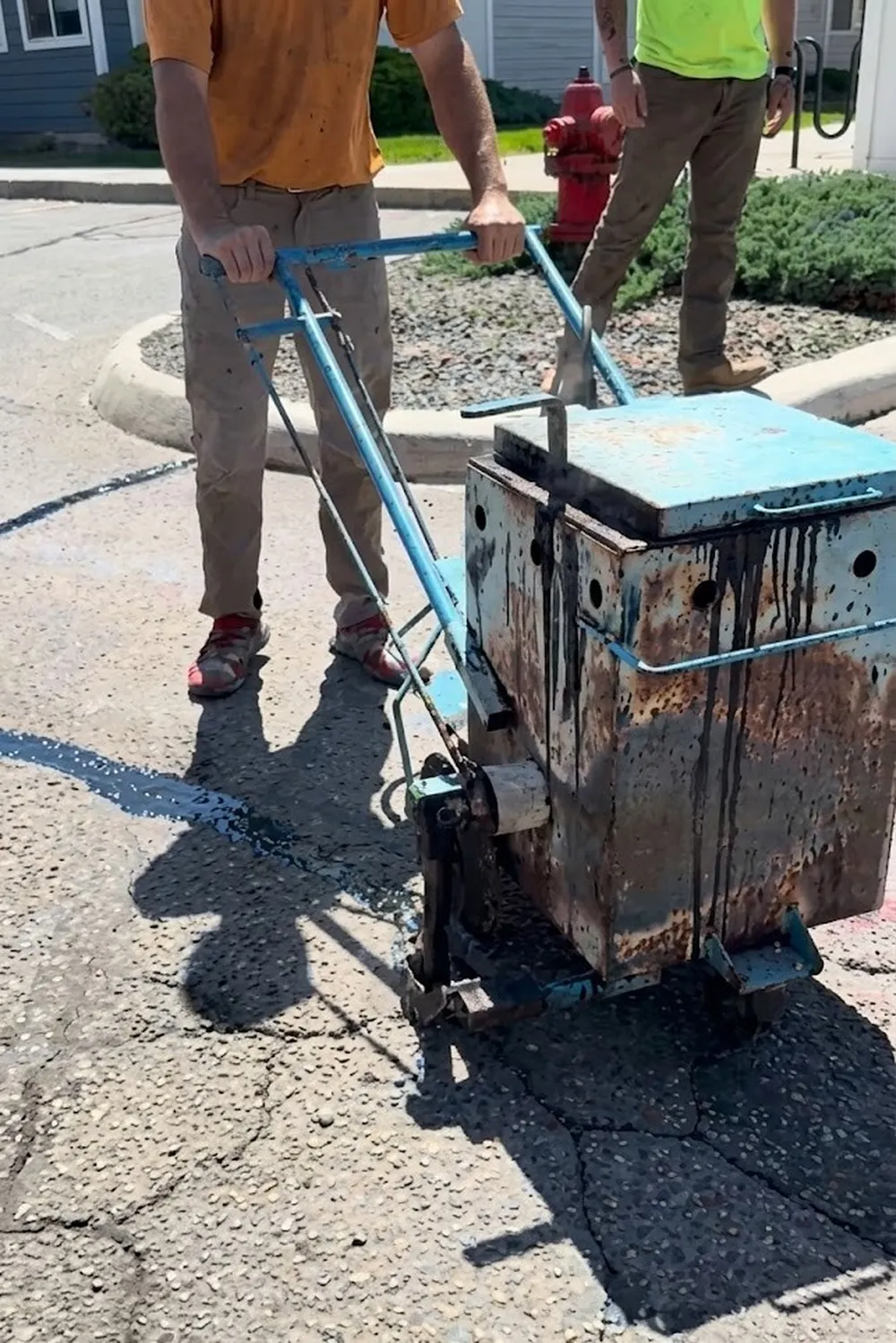
The same way as any repairable crack. The type, width and depth get assessed, the inside of the crack is cleaned out so the sealant bonds to pavement rather than to debris, and hot pour sealant is worked in until the void is full and the seal is watertight.
Then the surface gets sealcoated, once the filler has cured. Crack filling and sealcoating together is the combination that keeps new cracks from opening. Sealing without filling does not close the cracks that are already there, and it traps moisture underneath them.
Transverse cracks in particular will reappear in roughly the same places, because the thermal stress that created them has not gone anywhere. That is normal and it is not a failed repair. What the filler does is keep water out of the base during the years in between.
Frequently asked questions
Do transverse cracks mean my driveway is failing?
No. They are the most normal form of cracking there is and they appear on sound pavement. What matters is whether they are sealed, because an open one lets water into the base.
Why are they evenly spaced?
Each crack relieves the thermal stress in the pavement around it, so the next one forms at roughly the distance where the stress builds back up. The spacing is a function of the material and the temperature swing.
Will they come back after being sealed?
The same lines usually move again, because the thermal cycle continues. A properly cleaned and filled crack lasts several years, longer when the surface is sealcoated regularly.
Is it better to seal cracks in fall or spring?
Fall, for this valley. Temperatures are moderate and there is less rain than in spring, and it puts the seal in place before the months that do the damage.
How often should the surface be sealed to keep ahead of them?
Every three to five years on a residential driveway, with wear usually showing around year three. Heavy commercial traffic moves that to about every two years.
Can these be sealed in winter?
Some products are made for colder application in urgent situations, but it is not the normal approach. Below about 40°F for most of the day the material will not flow into the crack, bond and cure the way it needs to.
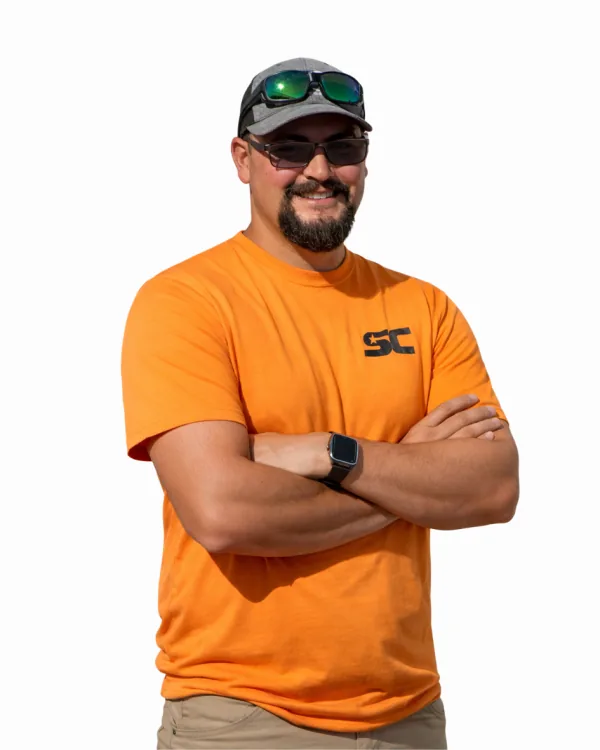
Written with Gideon Duarte
Gideon is Co-Owner of Select Coatings. This article uses the same pavement checks and plain-language recommendations the team explains before residential, commercial and HOA work across the Treasure Valley.
Meet Select CoatingsNeed an expert opinion on what you are seeing?
Fall is the right window in this valley, and the calendar is shorter than people think. We respond within 24 hours.