
What causes longitudinal cracks in asphalt?
Longitudinal cracks run with the direction of traffic, usually along a paving seam or a utility trench. What causes them and when sealing is still enough.
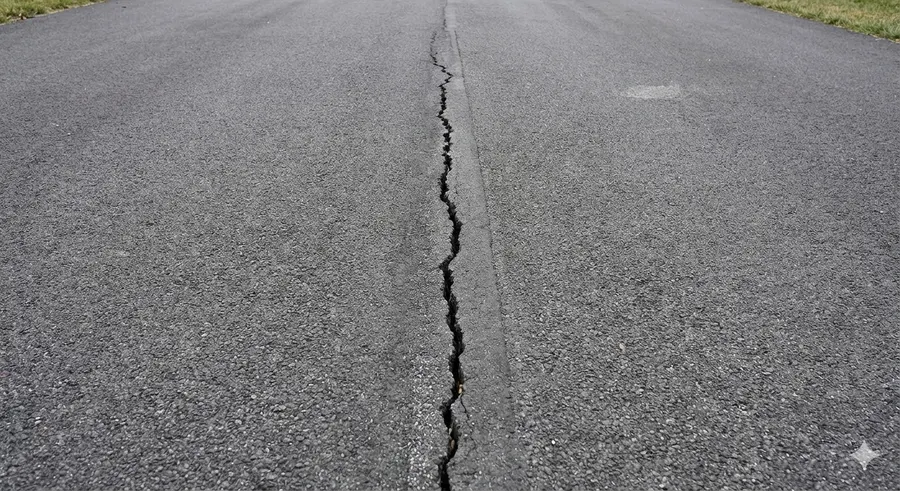
Longitudinal cracks run in the same direction as traffic, usually along a seam where two passes of paving met, over a utility trench, or above a line where the base is moving. They are easy to seal while they are narrow. Left open, they let water straight into the base.
Where do longitudinal cracks usually appear?
Along a seam. When a lot or a road is paved, the machine lays material in passes, and the joint between two passes is the weakest line on the surface. It is the first place to open as the pavement ages, and it opens in a straight line because that is the shape of the joint.
The second common location is over a utility trench. When a line is cut into a lot and backfilled, the backfill settles at a different rate than the ground that was never disturbed. A crack forms along the edge of the trench, straight and often unnervingly neat.
The third is over a line where the base is moving underneath. Those look less regular and they usually come with other symptoms, like a slight dip or cracking that starts to branch.
Are longitudinal cracks serious?
Not at first, and they get serious faster than people expect. A narrow longitudinal crack is a surface condition. What makes it worse than an isolated crack is its length. A joint crack can run the full length of a driveway or a drive aisle, which means it is not one entry point for water, it is a hundred feet of entry point.
Water that gets in along that line saturates the base underneath it. Once the base softens, the crack stops being a line and starts becoming a strip, and the shoulders of it break down into loose material.
| What you see | Likely cause | What it needs |
|---|---|---|
| Straight crack down the middle of a drive | Paving joint | Clean and seal |
| Straight crack along a line that was dug up | Trench settlement | Seal, or patch if the surface has dropped |
| Crack with a visible dip along it | Base moving | See sinking and uneven areas |
| Crack within 12 to 24 inches of the pavement edge | Lack of support | See edge cracks |
| Crack branching into a connected web | Base has failed | See alligator cracking |
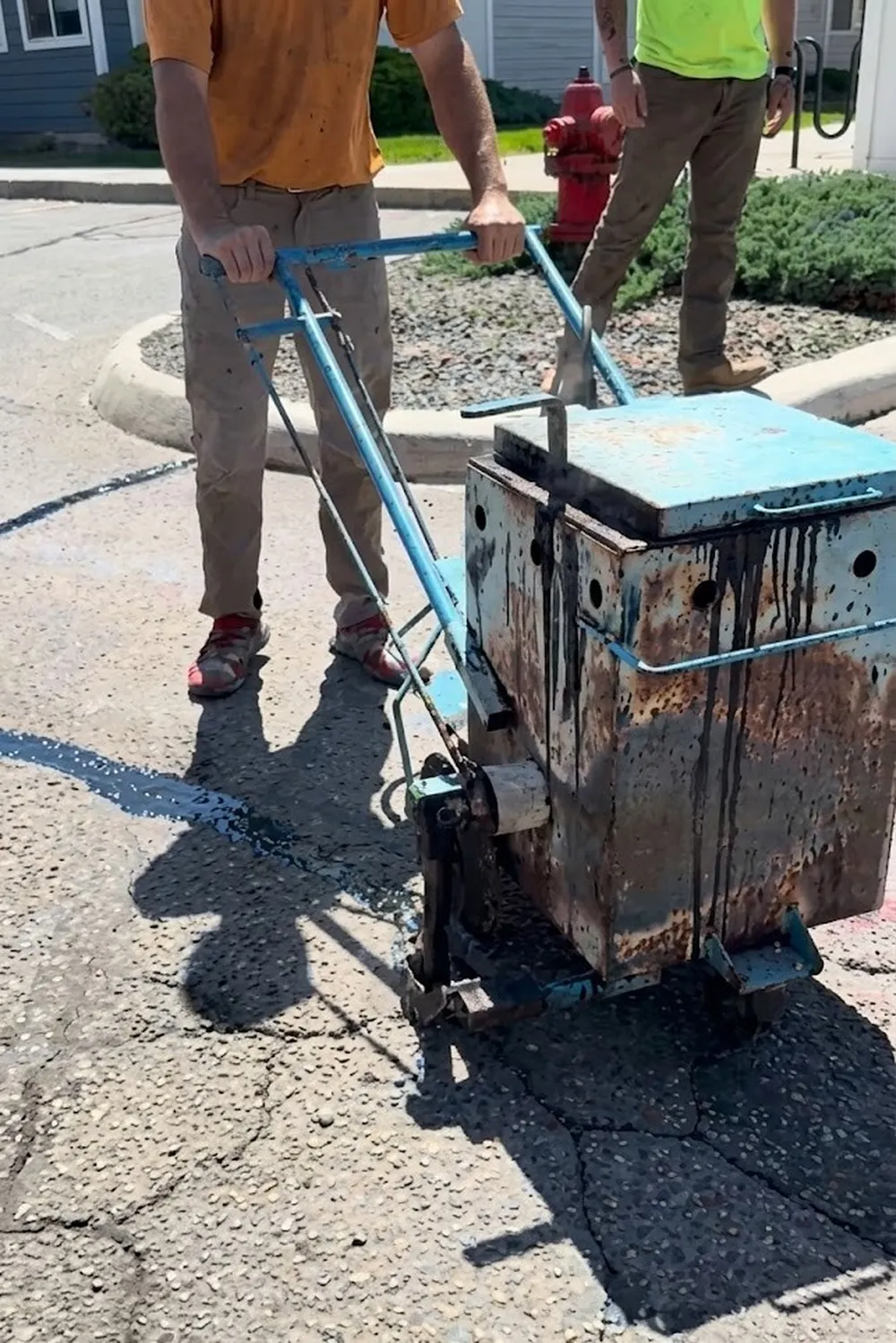
How are longitudinal cracks repaired?
By cleaning the crack out and filling it, as long as the pavement on both sides is solid. The inside of the crack is cleared of debris, dirt, vegetation and loose material, because sealant bonds to whatever it touches and material in the crack means it bonds to that instead of the pavement. Then hot pour sealant is worked in until the void is full and the seal is watertight.
Where there are many small cracks in one area rather than a single line, the crew may use a bucket of gator patch instead. That is a type III slurry with extra sand in it, applied as a patching compound over the whole affected area rather than crack by crack.
Why does a crack keep coming back in the same place?
Because the thing causing it is still there. This is the question worth asking about any longitudinal crack over a trench. Gideon Duarte, Co-Owner of Select Coatings, gets called once or twice a year to repair another contractor's work, and the pattern repeats.
On one property a utility company dug in the lot, another contractor came in and restored the asphalt, and those patches started failing quickly. The crew removed the failed repair, corrected the base underneath, and repatched it. The first repair had replaced what you could see and left the reason underneath it.
If a crack reopens along the same line within a season or two, the base under that line is moving, and no amount of sealant will hold it still.
When does a longitudinal crack stop being a sealing job?
When the pavement beside it is no longer solid. A patch needs solid asphalt on all four sides so the new material bonds to something stable. When one side of a long crack has broken down, or the surface has dropped along it, that section gets cut out and rebuilt rather than filled.
Gideon's working rule of thumb is that a crack much wider than an inch has passed the point where filling it makes sense and is heading toward a patch. Width alone does not decide it. What the surface does when you stand on either side of the crack decides it.
Frequently asked questions
Is a longitudinal crack a sign of bad paving?
Usually not. Joints between paving passes are normal construction, and they open as the surface ages. What is worth asking is whether the joint was tight when it was built, because a poorly closed joint opens earlier.
Should the whole joint be sealed or just the open part?
Seal the full run. Sealing a portion leaves the rest of the joint open, and water travels along a joint. It is also cheaper to do the run once than to come back for the next section next year.
Can I fill it myself?
A narrow crack on solid pavement, yes. Consumer crack filler is less durable, bonds poorly in wide or deep cracks, and is unlikely to hold through a winter here.
Does sealcoating close a longitudinal crack?
No. Sealcoating is a surface coating and cannot fix a crack that is already open. Sealing over it traps moisture underneath. Crack filling comes first and gets time to cure, then the surface is sealed.
We are having a utility line put in. What should we ask for?
Ask who is responsible for restoring the asphalt and how the trench will be backfilled and compacted. That conversation before the work costs nothing. A failed trench restoration can otherwise turn into a second repair project.
Do these show up more on commercial lots?
They show up wherever there are joints, and a parking lot has far more of them than a driveway. On a large lot they tend to appear in the drive aisles first, which is where the paving passes and the traffic both concentrate.

Written with Gideon Duarte
Gideon is Co-Owner of Select Coatings. This article uses the same pavement checks and plain-language recommendations the team explains before residential, commercial and HOA work across the Treasure Valley.
Meet Select CoatingsNeed an expert opinion on what you are seeing?
That is usually a base question, not a sealant question. Send us the location and a photo and we will tell you which. We respond within 24 hours.