
What causes edge cracks in asphalt and how are they fixed?
Edge cracks form where pavement has no curb or shoulder holding it. What causes them in the Treasure Valley, when sealing is enough, and how to stop them coming back.
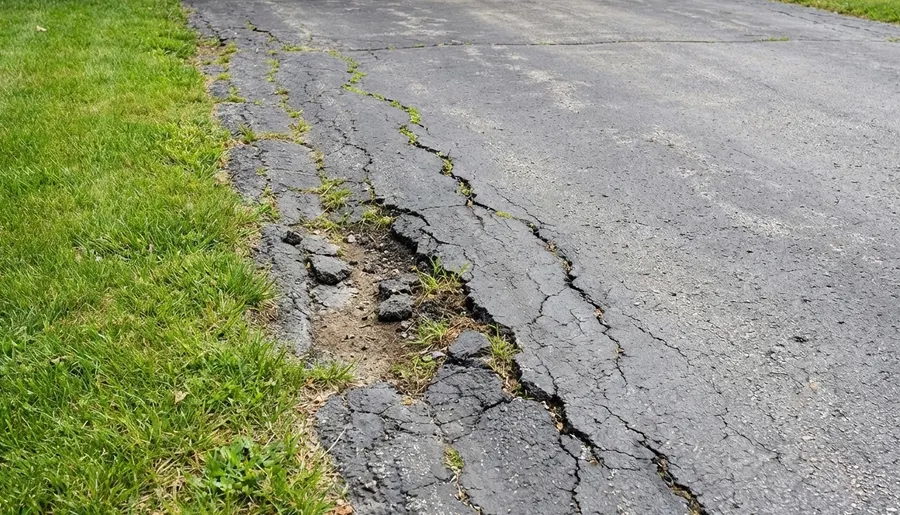
Edge cracks form within a foot or two of an unsupported pavement edge, where no curb or shoulder holds the asphalt in place. Vehicles drift off the edge, the soil underneath gives way, and the asphalt breaks along the line. Fixing them means sealing the crack and then supporting the edge.
What causes edge cracks in an asphalt driveway or parking lot?
Lack of lateral support causes them. Asphalt at an unconfined edge has nothing holding it sideways. Every vehicle that runs a wheel over that edge pushes down on soil that can move, and the pavement bends until it cracks. Water that collects along the same edge softens the soil further and speeds the whole process up.
You can usually tell an edge crack from the others by where it sits. It runs alongside the edge rather than out into the middle of the surface, and the material on the outside of the crack often sits slightly lower than the material on the inside. That drop is the soil giving way.
Why do edge cracks get worse in the Treasure Valley?
Two local conditions make edge failure worse here. The soils are silt loam over a strongly cemented duripan 20 to 40 inches down, so water soaks into the silt and perches on that layer instead of draining away. And the irrigation system charges from about April through October, which raises water tables under and beside a large share of parking lots and private drives.
The result is a subgrade that can be dry and stiff in March and saturated in June. Saturated silt has very little bearing strength. An edge that carried traffic fine all winter can start breaking away in the middle of irrigation season, which is why the failure often looks like it came out of nowhere.
This is not the expansive clay story you read on national sites. Clay swells and shrinks. Our problem is frost heave in silt and water trapped above a hard layer, and it calls for a different fix.
Can edge cracks be sealed, or do they need a patch?
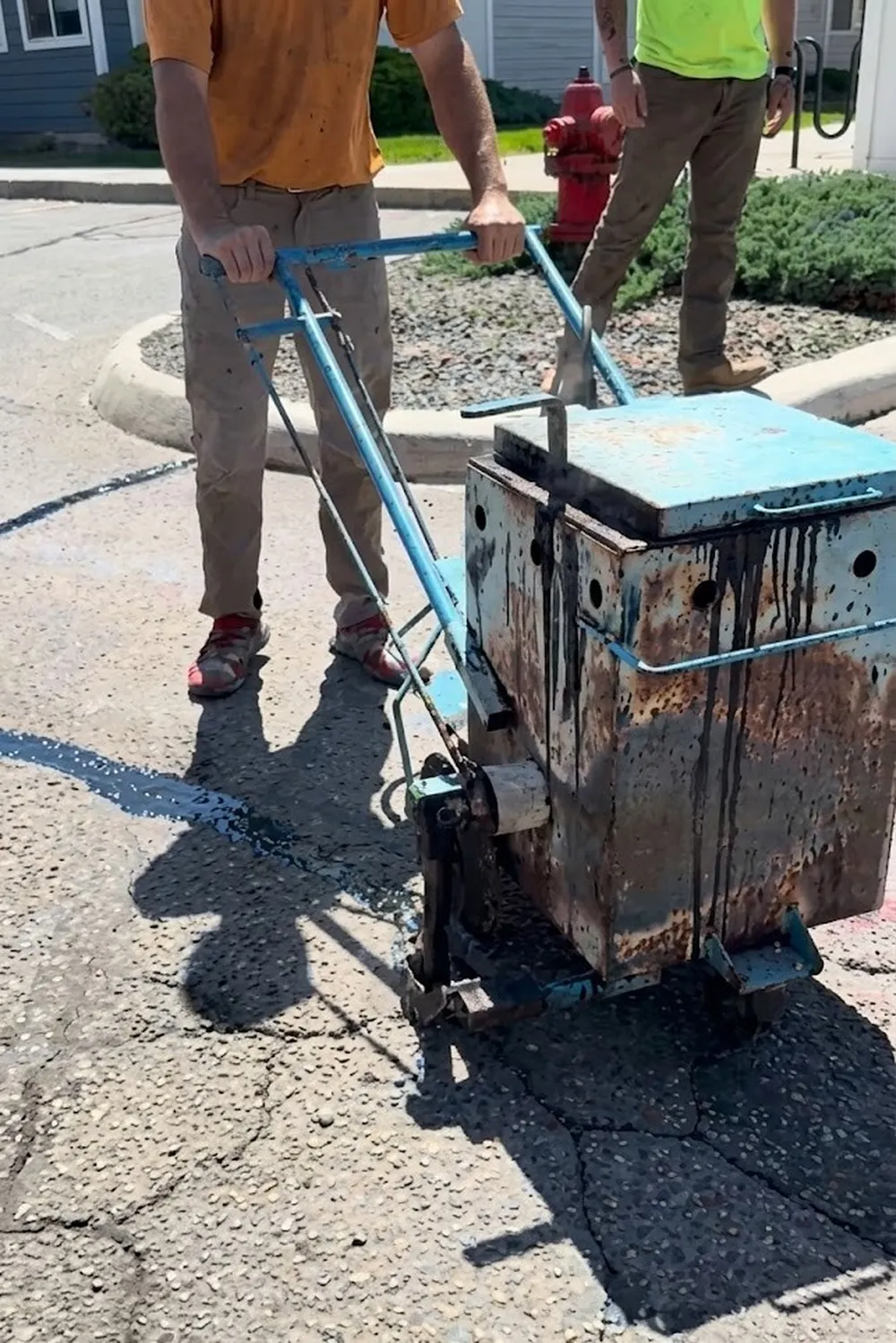
Most edge cracks can be sealed if the pavement on both sides is still solid. The crack gets cleaned out down inside, then filled with hot pour sealant worked in until the void is full and the seal is watertight. If the edge has already crumbled into loose pieces, or the asphalt flexes underfoot, sealant will not hold it and the section needs cutting out and patching.
The test is whether there is solid asphalt to bond to. When Gideon Duarte, Co-Owner of Select Coatings, plans a patch, he looks for solid pavement on all four sides so the new material bonds to something stable. An edge that has lost its support does not offer that on one side, which is the reason edge repairs get treated differently from a crack out in the field.
Cleaning is the part people skip. Sealant poured over dirt, vegetation or loose material bonds to the debris rather than the pavement, and it lifts out within a season.
How do you stop edge cracks from coming back?
Sealing the crack treats the symptom. Supporting the edge treats the cause, and on an uncurbed edge that means building material up against the asphalt so it has something to lean on. Gideon uses a shoulder of landscaping rock or three quarter inch minus, packed against the finished edge after the crack is filled.
That shoulder does two jobs. It gives the pavement something to lean against, and it means a wheel that leaves the asphalt rolls onto material instead of dropping off a lip. On a lot with curbing the curb already does this, which is why edge cracking on curbed lots usually points to drainage instead of support.
After the crack is filled, sealcoating over the repaired area keeps water out of the surface around it. Crack fill and sealcoat together is the combination that prevents new cracks. Neither one alone does much for an edge.
What happens if you leave edge cracks alone?
Water gets in and the failure spreads inward. An open edge crack is a channel straight into the base. Once the base is wet it loses strength, the pavement above it starts moving, and what began as one line along the edge turns into a broken strip and then into a pothole.
The timing here is the problem. Nearly 56 percent of the year's precipitation falls between November and March at Boise Air Terminal, which is exactly when it is also freezing. Water goes into the crack, freezes, expands, and opens it wider for next time. An edge crack that is easy to seal in September can be a patch by April.
| Condition | What it needs |
|---|---|
| Hairline crack along a solid edge | Clean and seal |
| Wider crack, pavement solid on both sides | Clean and seal, then support the edge |
| Edge crumbling, loose pieces | Cut out and patch, then support the edge |
| Edge broken away with soil loss underneath | Patch and rebuild the shoulder |
| Alligator pattern spreading in from the edge | Base failure. See what alligator cracking means |
Frequently asked questions
How close to the edge does a crack have to be to count as an edge crack?
Generally within 12 to 24 inches of the pavement edge and running parallel to it. Cracks further in with no relationship to the edge are usually longitudinal or transverse cracks with different causes.
Can I fill an edge crack with a product from the hardware store?
For a narrow crack on a solid edge you can. Consumer crack filler is less durable, bonds poorly in wide or deep cracks, and is unlikely to hold through a full winter here. It also does nothing about the missing support, which is what caused the crack.
Does sealcoating fix edge cracks?
No. Sealcoating is a surface coating and it cannot fix a crack that is already there. Sealing over an open crack does not close it and traps moisture underneath. Cracks get filled first and allowed to cure, then the surface gets sealed.
Should the shoulder be built before or after the crack is sealed?
The crack gets cleaned and sealed first, then the shoulder goes in against the finished edge. Building material against an open crack just buries it.
How long does an edge crack repair last?
A properly cleaned and filled crack lasts several years, and longer when the surface is sealcoated on a regular interval. If the edge support is never addressed, expect the crack to reopen in roughly the same place.
Do commercial lots get edge cracks too?
Yes, most often along drive lanes and back entrances where there is no curb and delivery vehicles cut the corner. It is one of the first things worth walking before a parking lot sealcoating project.

Written with Gideon Duarte
Gideon is Co-Owner of Select Coatings. This article uses the same pavement checks and plain-language recommendations the team explains before residential, commercial and HOA work across the Treasure Valley.
Meet Select CoatingsNeed an expert opinion on what you are seeing?
Send us the square footage and a photo of the edge and we will tell you which one it is. We respond to estimate requests within 24 hours.