
What do hairline cracks in asphalt mean?
Hairline cracks are the earliest stage of asphalt failure and the cheapest to stop. What causes them, the test Gideon uses, and when sealcoating still works.
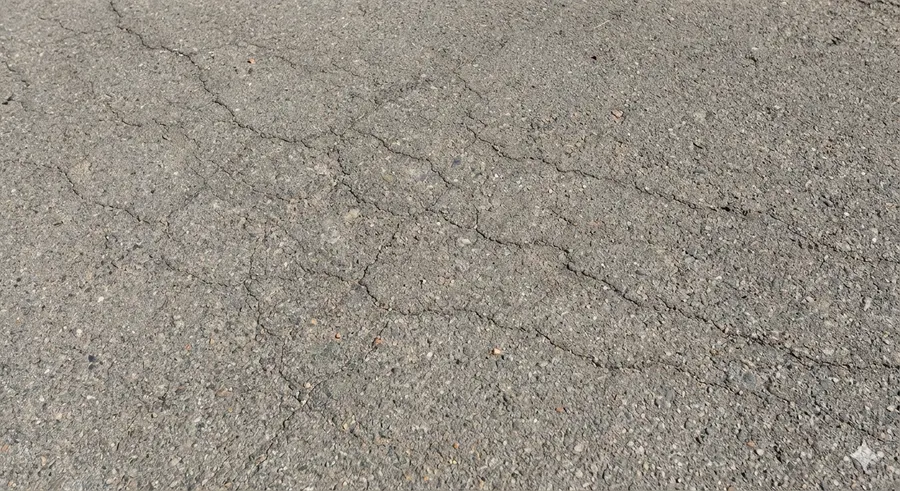
Hairline cracks are the earliest stage of asphalt failure and the easiest to stop. They appear as the surface oxidizes and loses its binder, which leaves the top layer porous and lets small rocks work free. At this stage crack filling and sealcoating still work, and nothing has to be cut out.
What causes hairline cracks in an asphalt driveway?
Sun and time cause them. Asphalt is held together by a binder, and ultraviolet light and oxygen break that binder down from the surface downward. As it goes, the top layer gets brittle and porous, the surface turns from black to gray, and it starts cracking in fine lines under normal expansion and contraction.
This is not damage in the way a pothole is damage. It is the surface aging. The reason it matters is what happens next, because every one of those fine lines is a route for water to get below the surface.
How do I know if my driveway is at this stage?
Go outside and put your hand on it. Texture tells you more than appearance does, because a surface can still look dark and already be porous. Gideon Duarte, Co-Owner of Select Coatings, uses a check you can do in ten seconds, rather than the water bead test people read about online.
Three other signs he tells homeowners to watch for: the surface looks gray and faded rather than black, more loose rock is showing up on the driveway, and there are more cracks this year than last year. Any two of those together means the surface has stopped protecting itself.
| What you find | What stage it is | What it needs |
|---|---|---|
| Black, tight surface, no loose rock | Sealed and holding | Nothing yet |
| Gray, slightly porous, a few fine lines | Hairline cracking | Sealcoat |
| Fine lines plus loose rock coming free | Hairline cracking, advanced | Crack fill, then sealcoat |
| Cracks wide enough to put a coin in | Past hairline | Crack repair first |
| A dip that holds water | Base problem | See sinking and uneven areas |
Do hairline cracks need to be filled before sealcoating?
The fine ones do not, the wider ones do. A true hairline crack is narrow enough that the sealer bridges it. Once a crack is open enough to take filler, it gets cleaned out and filled first and allowed to cure, and only then does the surface get sealed.
The order is not optional. Sealing over an open crack does not seal the crack, and it traps moisture underneath. The crack reappears through the new sealer within a season and the water is still down there doing damage.
On our estimates crack filling shows as its own line item rather than being folded invisibly into the price, so you can see what it costs and decline it if you would rather not.
Why do hairline cracks get worse over winter here?
Because the water and the freezing arrive in the same months. Boise Air Terminal records 11.73 inches of precipitation a year, and 55.6 percent of it falls between November and March. That is also the stretch when overnight temperatures drop below freezing and daytime temperatures climb back above it.
Water goes into the crack, freezes, expands, and opens it a little wider. Then it thaws and more water gets in. A crack you could barely see in October is visible from the porch in April. That is the whole mechanism, and it is why sealing before winter matters more in this valley than drainage does.
What does sealcoating actually do at this stage?
It replaces the protective layer the surface has lost. Two coats go on every job regardless of size, both sprayed, with the edges cut in by hand using horse hair brushes. The coating keeps ultraviolet light and water off the asphalt underneath so the binder stops breaking down.
What it will not do is worth saying plainly. Sealcoating is a barrier on top of the asphalt, and the barrier has to wear off before daily traffic starts eating away at the pavement again. It cannot fix a crack that is already open, and it will not make a driveway look new if there is a pothole or a low spot in it.
How often should a driveway be sealcoated?
Every three to five years for most residential driveways, with wear normally showing around year three. Gideon uses the same commercial grade product on driveways that goes on parking lots rather than switching to a lighter duty material, and he has seen that push some surfaces closer to five years than three.
Treat that as an example rather than a promise. How long a coat lasts depends on traffic, sun exposure, how well the surface was prepared, and the condition it was in when the sealer went on.
Frequently asked questions
Are hairline cracks a sign my driveway was built badly?
No. Every asphalt surface oxidizes. Hairline cracking is what that looks like, and it shows up on well built pavement as reliably as on poor pavement. What differs is how soon.
Can I just sealcoat and skip the crack filling?
If the cracks are genuinely hairline, yes, the sealer bridges them. Once they are wide enough to take filler, skipping that step means sealing water underneath your new coating.
Is it worth sealcoating a driveway that only has a few hairline cracks?
That is the best time to do it. The work is cleaning, filling and coating, with nothing to cut out and no patching. A driveway with sealcoating and crack filling on a regular interval can last north of 20 years.
How long before I can park on it?
About two hours for foot traffic, or an hour when it is above 80°F. For vehicles, 12 hours is often enough but we ask for 24, because driving on it sooner is what voids the warranty.
Does a commercial lot get hairline cracking too?
Yes, and on the same schedule, except heavy commercial traffic wears the coating off faster. A lot carrying trucks is usually back on a roughly two year cycle rather than three to five.
What is the cheapest mistake to avoid?
Waiting. Sealing a surface with hairline cracks is the least expensive work we do. Tearing out and repaving runs about $4 per square foot.

Written with Gideon Duarte
Gideon is Co-Owner of Select Coatings. This article uses the same pavement checks and plain-language recommendations the team explains before residential, commercial and HOA work across the Treasure Valley.
Meet Select CoatingsNeed an expert opinion on what you are seeing?
Send a photo taken close enough to see the texture and we will tell you. We respond within 24 hours.